
Why Are Stars Different Colors? The Hidden Meaning Behind Blue, Red, and Golden Stars
Have you ever looked up at the night sky and noticed that not every star looks the same?
Some stars shine with a soft golden glow. Some look white. Some appear orange or red. And if the sky is clear enough, you may even notice a few stars with a faint blue sparkle.
It feels magical, almost like the universe is painting with different colors. But here is the beautiful secret:
A star’s color tells us how hot it is.
Yes, the color of a star is not random. It is not just decoration in the sky. It is one of the clearest clues astronomers use to understand the temperature, energy, and nature of a star. In traditional astrology, these distant suns are known as “Fixed Stars,” and their colors can hint at their profound astrological nature and influence.
What Do Star Colors Mean?
Stars are giant balls of glowing gas. They produce light and heat from deep inside their cores. But not all stars burn at the same temperature. That is why they shine in different colors.
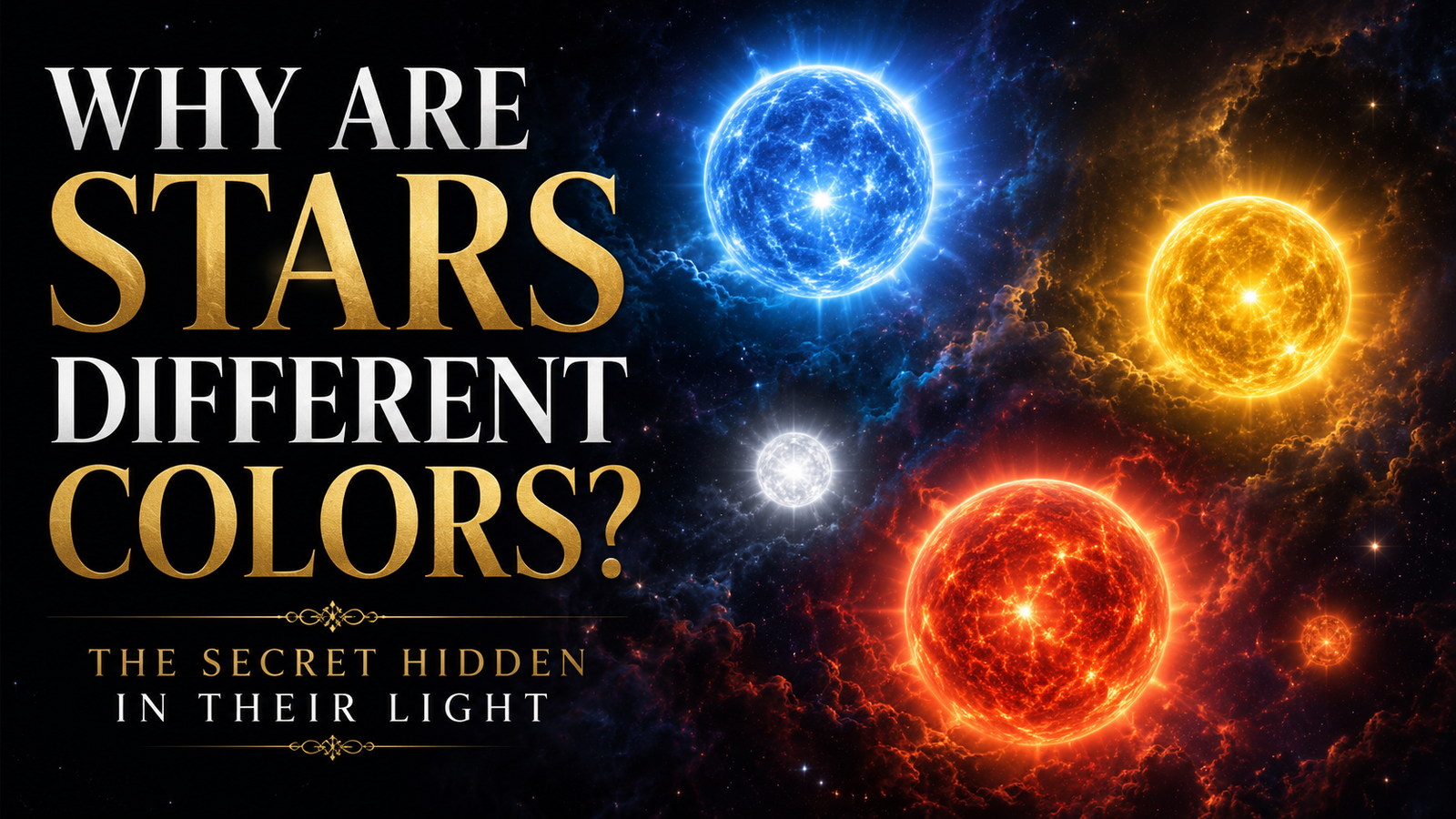
A cooler star gives off a warmer-looking color, like red or orange. A hotter star gives off a sharper, brighter color, like white or blue.
It sounds strange at first because we often think of red as “hot” and blue as “cool.” But in space, it works differently. Blue stars are the hottest stars. Red stars are the coolest stars.
Think of heated metal. When metal first gets hot, it glows red. As it becomes hotter, it turns orange, then white, and eventually blue-white. Stars follow the exact same rule of physics.
To see how temperature dictates color, you can interact with the stellar scale here:
Stellar Temperature Scale
5,800 K
Class: G (Yellow) – Example: Our Sun
Blue Stars: The Hottest and Most Powerful
Blue stars are the fire giants of the universe.
They burn with extreme heat and powerful energy. Their surface temperatures can rise above 33,000 K, making them much hotter than our Sun. These stars are usually massive, bright, and intense. They do not live as long as smaller stars because they burn through their fuel quickly.
- Look for them: Sirius (the brightest star in the night sky) and Rigel (in the constellation Orion) are famous, brilliant blue-white stars.
Spiritually, blue stars feel like symbols of intensity, awakening, higher vision, and cosmic power. They remind us that some lights are born to burn boldly, even if only for a shorter time.
White and Bluish-White Stars: Bright, Sharp, and Radiant
Some stars look pure white or bluish-white. These stars are still incredibly hot, though not always as extreme as deep blue stars. They give the night sky a clean, diamond-like sparkle.
- Look for them: Vega and Altair are beautiful examples of brilliant white stars.
These stars are connected with clarity, purity, and strong energy. When you see a white star, you are looking at a sun far away that is burning much hotter than many orange or red stars.
Yellow Stars: The Familiar Glow of Our Sun
Our own Sun is a G-type star. While it emits peak energy in the green part of the spectrum and actually appears pure white from space, it looks beautifully yellow to us from Earth because our atmosphere scatters away the blue light.
Its surface temperature is around 5,300 to 6,000 K. That may sound unbelievably hot, and it is. But compared to blue stars, the Sun is actually quite moderate.
This is one reason the Sun feels so balanced in symbolic astrology. It gives life, warmth, growth, rhythm, and visibility. It is not the hottest star in the universe. But for us, it is the most important one. It is the star that wakes the world every morning.
Orange Stars: Warm, Steady, and Long-Lived
Orange stars are cooler than yellow stars but still very powerful. They belong to the K-type star class, with temperatures around 3,900 to 5,300 K.
These stars often burn more slowly than hotter stars, which can make them incredibly stable and long-lasting.
- Look for them: Aldebaran (the fiery eye of Taurus) and Arcturus glow with a distinct, beautiful orange hue.
In symbolic language, orange stars feel like patience, endurance, wisdom, and quiet strength. They do not need to shout across the universe. They simply keep glowing.
Red Stars: The Coolest Stars in the Sky
Red stars are the coolest stars in the main stellar color sequence. Their temperatures can drop as low as 2,300 K and may reach up to around 3,900 K.
But do not let the word “cool” fool you. These stars are still incredibly hot by human standards. Red stars are often smaller and longer-lived, though some are massive dying giants.
- Look for them: Betelgeuse (the shoulder of Orion) and Antares (the beating heart of Scorpio) are famous red supergiants that are easy to spot.
Spiritually, red stars represent ancient energy, survival, grounding, hidden strength, and deep cosmic memory. They are the slow burners of the galaxy.
Stellar Classification by Color and Temperature
Astronomers classify stars using a system based on temperature and color. The main sequence goes from the hottest stars to the coolest stars:
- O-type: Blue (Above 33,000 K)
- B-type: Bluish white (10,000–33,000 K)
- A-type: White (7,300–10,000 K)
- F-type: Yellowish white (6,000–7,300 K)
- G-type: Yellow (5,300–6,000 K) Our Sun belongs to this class.
- K-type: Orange (3,900–5,300 K)
- M-type: Red (2,300–3,900 K)
A simple way to remember the order from hottest to coolest is: O, B, A, F, G, K, M.
Why Do Some Stars Look White to Us?
Here is where the human touch comes in. Sometimes stars do have color, but our eyes cannot easily see it.
Many stars look white to the naked eye simply because they are too faint. Human eyes need a certain level of brightness to notice color clearly, especially at night. That is why bright stars often show their true color more easily than dim stars.
If you use binoculars or a telescope, the hidden colors of the cosmos suddenly reveal themselves. You may begin to see soft gold, pale blue, burnt orange, and deep red tones that were hidden just moments before.
The universe was colorful all along. We just needed to look a little closer.
Why Star Colors Matter
The next time you look at the night sky, do not just count the stars. Notice them.
Look for the golden ones. Search for the orange ones. See if you can spot a blue-white sparkle. Pay attention to the stars that look warmer or cooler than the rest. Because every color is telling a story.
A blue star is telling you it burns with extreme heat. A red star is telling you it glows with slower, ancient energy. A yellow star, like our Sun, reminds us that the perfect balance of light and warmth can create life.
The sky is not just full of stars. It is full of distant suns, each carrying its own temperature, rhythm, color, and cosmic personality. And the next time someone asks, “Why are stars different colors?” you will know the answer: because every star burns differently.
Now, it's your turn to look up. Drop a comment below with your Zodiac sign, and tell us: which star color do you feel most drawn to and why?
Why are stars different colors?
Stars are different colors because they have different surface temperatures. Hotter stars appear blue or white, while cooler stars appear orange or red.
Are blue stars hotter than red stars?
Yes. Blue stars are much hotter than red stars. Red stars are cooler compared to blue, white, and yellow stars.
What color is the Sun?
The Sun is a G-type star. It appears yellowish-white and has a surface temperature of about 5,300 to 6,000 K.
What does a red star mean spiritually?
Spiritually, a red star can symbolize grounding, survival, ancient wisdom, passion, and deep cosmic energy.